Lesson 11: Logic and Proof
Introduction
We’ve reached a pivotal moment in our journey. So far, we’ve honed our skills in crunching numbers, manipulating expressions, and solving equations and inequalities—tools that let us tackle real-world physics problems. That’s all great stuff, but mathematics and theoretical physics aren’t just about plugging in values and getting answers. Sometimes, to crack a tough puzzle—like explaining why gravity bends light or why quantum particles behave so strangely—we have to dream up entirely new ideas or mathematical frameworks. And before we can trust those innovations, we need solid proof that they’re not just clever guesses but actual truths. That’s where this lesson comes in: we’re shifting gears from mere calculation to the art of logical reasoning and proof, giving you the toolkit to build, test, and verify your own mathematical and physical arguments.
In the sections ahead, we’ll start with the basics—breaking down simple true-or-false statements We’ll learn how to connect these ideas with logical “glue” (things like “and,” “or,” and “if-then”), use truth tables to check when combinations hold water, and spot when two ways of saying something are really the same (logical equivalence). From there, we’ll expand to bigger claims, using predicates to describe properties of objects and quantifiers to say “for all” or “there exists” in a precise way. We’ll dive into axiomatic systems as the foundation of math, formalize everyday equations and inequalities, and explore proof techniques: direct proofs for straightforward cases, contradiction to show what can’t be, and contrapositive for clever reversals.
As always, we’ll harness the Wolfram Language for hands-on verification—functions like `BooleanTable` for truth checks, `ForAll` and `Exists` for quantifying claims, and even `FindEquationalProof` to automate proving algorithms. By the end, you’ll not only understand how to construct airtight proofs but also how to analyze logic computationally, empowering you to invent and validate your own ideas in theoretical physics.
Logical Statements
In mathematics and physics, we make claims about the world—like an object moving at a constant speed or two numbers summing to a specific value. Such statements must be either true or false. Such claims form the foundation of all logical reasoning, we call them logical statements. Another name given is a proposition. In this way we a proposing something that is either is either true or false, but not both. For example, “The ball is at rest” is true or false depending on the situation, making it a logical statement. However, a question like “How fast is the ball moving?” or a command like “Measure the distance!” cannot be true or false, so they are not logical statements.
These true-or-false claims are essential for building arguments in mathematics and physics. To simplify our work, we use symbols like p or q to represent them. For instance, we might let p stand for “The object has zero acceleration” and q for “The net force is zero.” By using symbols, we can focus on the logical structure of our reasoning.
Exercise 11.1:
a) Determine whether each of the following is a logical statement (true or false proposition) or not. If not, explain why.
1) The particle’s velocity is 10 m  .
.
2) Calculate the force.
3) Is the object accelerating?
Hint: Check if it can be definitively true or false.
b) Classify these as logical statements or not: If it is a statement, state a scenario where it’s true and one where it’s false. Hint: Logical statements must assert something verifiable.
1) Gravity pulls objects downward.
2) What is the mass of the ball?
3) The net force equals mass times acceleration.
c) Identify which are logical statements:
1) 2 + 3 = 5
2) Solve for x in x + 4 = 7
3) The equation  = 4 has two solutions.
d) List three examples of non-logical statements from physics (e.g., questions or commands) and rewrite each as a logical statement. For example, change “Measure the distance” to “The distance is 5 meters.” Hint: Add specifics to make them declarative.
e) Evaluate the truth of these statements in a given scenario (e.g., a ball rolling at constant speed):
1) The ball has zero acceleration.
2) Friction is acting on the ball.
3) The ball’s kinetic energy is changing.
Logical Connectives
To reason about the physical world, we often combine simple claims—like “The object is moving” or “The force is applied”—to form more complex ideas. The tools that allow us to link these claims together in precise ways are called logical connectives. These are operations that combine logical statements to create new statements with their own truth values. For example, consider the statements “The velocity is constant” (let’s call it p) and “The net force is zero” (call it q).
The most common ways to combine statements include saying “both are true” (this is called a conjunction, written p and q, or p∧q), “at least one is true” (this is called a disjunction, written p or q, or p∨q), “if one, then the other” (this is an implication, sometimes called a conditional, written if p then q, or p⇒q), and “one is false” (this is called a negation, written not p or ¬p). Each of these combinations has specific rules for determining whether the resulting statement is true or false, which we’ll explore in the next section.
Terms and Definitions
Term/Definition 11.1 Logical statement (or proposition): A declarative claim that is either true or false (but not both); the foundation of logical reasoning (e.g., "The ball is at rest").
Term/Definition 11.2 Non-logical statement: Questions ("How fast is the ball moving?") or commands ("Measure the distance!") that cannot be true or false.
Term/Definition 11.3 Symbolic representation: Using letters (p, q, r, etc.) to stand for logical statements for clarity and focus on structure (e.g., p = "The object has zero acceleration").
Term/Definition 11.4 Logical connective: An operation that combines two or more logical statements to form a new statement with its own truth value.
Term/Definition 11.5 Conjunction (symbol ∧ or "and"): A logical connective that is true only if both statements are true (p ∧ q).
Term/Definition 11.6 Disjunction (symbol ∨ or "or"): A logical connective that is true if at least one statement is true (p ∨ q).
Term/Definition 11.7 Implication (symbol ⇒ or "if...then"): A logical connective that is true unless the premise is true and the conclusion is false (p ⇒ q).
Term/Definition 11.8 Negation (symbol ¬ or "not"): A logical connective that reverses the truth value of a statement (¬p is true when p is false).
Assumptions (the implicit beliefs the author relies on)
Assumption 11.1: Logical reasoning is built on true/false statements (propositions).
Assumption 11.2: Questions and commands are not propositions — they cannot be assigned truth values.
Assumption 11.3: Using symbols (p, q) for statements simplifies analysis of logical structure.
Assumption 11.4: Logical connectives (and, or, if-then, not) are precise tools for combining claims.
Assumption 11.5: Physical laws and observations can be expressed as logical statements (e.g., “net force is zero” ⇒ “acceleration is zero”).
Assumption 11.6: Logical statements are the building blocks of scientific arguments — true/false claims about the world.
Principles
Principle 11.1: Logical statements (propositions) are declarative claims that are either true or false — the foundation of reasoning in math and physics.
Principle 11.2: Only declarative sentences qualify as logical statements; questions and commands do not.
Principle 11.3: Logical connectives combine simple statements into complex ones with defined truth values:
Principle 11.4: Conjunction (and, ∧) is true only if both are true.
Principle 11.5: Disjunction (or, ∨) is true if at least one value is true.
Principle 11.6: Implication (if-then, ⇒) is false only if the premise is true and the conclusion is false.
Principle 11.7: Logical reasoning builds arguments by combining claims with connectives to deduce conclusions.
Exercise 11.2: Begin with Term/Definition 11.1 and copy it into your notebook. Reflect on its meaning for a few minutes. Note any thoughts that come to mind. How would you explain this to someone sitting in front of you. Write this down. Then do this for each term/definition, assumption, and principle.
Exercise 11.3:
a) Identify the logical connective in each sentence:
1) The object is accelerating and the force is nonzero.
2) The velocity is constant or the net force is zero.
3) If the object is at rest, then no force acts.
b) Let p = “The particle has constant velocity” and q = “The net force is zero.” Rewrite these using symbols:
1) The particle has constant velocity and the net force is zero.
2) The net force is zero or the particle accelerates.
Truth Tables
As we saw in the previous section, we often combine statements like “The object is accelerating” and “A force is applied” to describe a system, but we need a clear way to determine when these combinations are true or false. This systematic approach, which lists all possible truth values for combined statements, is called a truth table. A truth table shows every possible combination of truth values for individual statements and the resulting truth value of their combination using logical connectives, such as “and” ∧, “or” ∨, “implies” ⇒, or “not” ¬.
For example, consider two statements: p: “The velocity is constant” and q: “The net force is zero.” To evaluate the statement “The velocity is constant and the net force is zero” p∧q, we list all possibilities: both true, p true and q false, p false and q true, and both false. The truth table reveals that p∧q is true only when both p and q are true, reflecting physical scenarios like an object in equilibrium under Newton’s first law.
To streamline this process, we can use the Wolfram Language’s `BooleanTable` function.

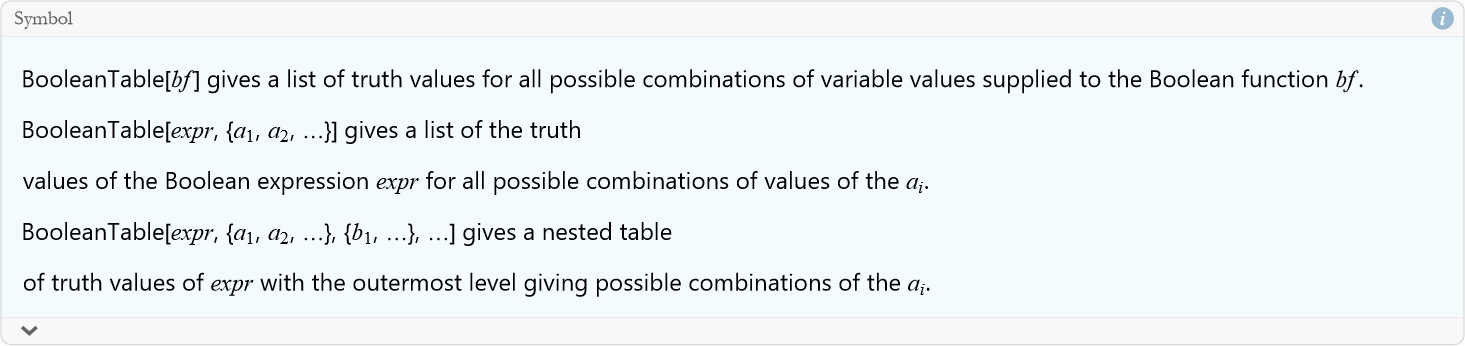
For instance, entering

generates a truth table for the connectives “and” (&&), “or” (||), and "implies" (→), displaying all possible truth value combinations for p and q.
| p |
q |
p∧q |
p∨q |
p⇒q |
| True |
True |
True |
True |
True→True |
| True |
False |
False |
True |
True→False |
| False |
True |
False |
True |
False→True |
| False |
False |
False |
False |
False→False |
Terms and Definitions
Term/Definition 11.9 Truth table: A systematic table that lists all possible truth value combinations for one or more logical statements and shows the resulting truth value of their combination using logical connectives.
Term/Definition 11.10 BooleanTable[] (Wolfram Language function): A command that generates a truth table for logical expressions and connectives.
Term/Definition 11.11 TableForm[] (Wolfram Language function): Formats output as a table with headings (used with BooleanTable for readable truth tables).
Assumptions (the implicit beliefs the author relies on)
Assumption 11.7: Truth tables systematically enumerate all possible combinations of truth values for statements and connectives.
Assumption 11.8: Truth tables help verify logical relationships (e.g., "velocity constant and net force zero" is true only when both are true).
Assumption 11.9: Physical laws and observations can be expressed as logical statements and analyzed with truth tables.
Principles
Principle 11.8: Truth tables list all possible truth value combinations for statements and show the result of logical connectives.
Principle 11.9: Use BooleanTable in WL to generate truth tables automatically for connectives (&&, ||, ->).
Principle 11.10: Truth tables are essential for rigorous reasoning.
Exercise 11.4: Begin with Term/Definition 11.9 and copy it into your notebook. Reflect on its meaning for a few minutes. Note any thoughts that come to mind. How would you explain this to someone sitting in front of you. Write this down. Then do this for each term/definition, assumption, and principle.
Exercise 11.5:
a) Create a truth table for p = “The object is accelerating” and q = “A force is applied” using the connective p∧q. List all possible combinations and determine when the statement is true. Hint: Use four rows (TT, TF, FT, FF).
b) Draw a truth table for p = “The velocity is constant” and q = “The net force is zero” with the connective p∨q. Explain a physics scenario where it’s true. Hint: True if at least one is true.
c) Construct a truth table for p = “A force is applied” and q = “The object moves” with p⇒q. Identify when it’s false and relate it to a physics example. Hint: False only when p is true and q is false.
d) For p = “The object is at rest,” create a truth table for ¬p∧q, where q = “A net force acts.” Describe a scenario where this is true. Hint: Consider four rows with ¬p computed first.
e) Build a truth table for (p⇒q)∧(¬p∨q), where p = “The system is isolated” and q = “Momentum is conserved.” Analyze the results. Hint: Use eight steps to compute each column.
f) Use the Wolfram Language to generate a truth table for p = “The object accelerates” and q = “A force is nonzero” with p∧q. Verify that the output matches hand-drawn expectations.
g) Write code to display a truth table for p = “Velocity is constant” and q = “Net force is zero” with p∨q. Interpret what it means when it is true.
h) Use BooleanTable to create a truth table for p = “Force is applied” and q = “Object accelerates” with p⇒q.
i) Generate a truth table for p = “Object is at rest” with ¬p and combine with q = “Net force acts” using ¬p∨q.
j) Write code to compute a truth table for (p⇒q) ∧ (¬p∨¬q), where p = “System is closed” and q = “Energy is conserved.”
Logical Equivalence
In physics, we often express the same idea in different ways, like saying “The net force is zero” or “The object is not accelerating.” When two statements convey the same truth under all conditions, we call this logical equivalence. This means that two logical statements have identical truth values for every possible combination of their components, as verified by truth tables or computational tools. We denote this symbolically with the tilde symbol, ~.
For example, consider the statements p: “The net force is zero” and q: “The object is at rest or moving at constant velocity.” These can be equivalent in certain contexts, such as when no external forces act. To confirm this, we can construct a truth table for a statement like p⇔q (this is called the biconditional, meaning “p if and only if q”) and check if it’s always true when the conditions align. Note that some authors contract “if and only if” to iff. Logical equivalence can help us to establish when two things are the same.
Using the Wolfram Language, we can test equivalence efficiently. Again, we use the `BooleanTable` function to compare two expressions, like

| True→True |
False→False |
| True→False |
True→False |
| False→True |
False→True |
| False→False |
True→True |
it is easy to verify if they produce the same truth values, confirming equivalence for statements like the contrapositive. This is invaluable in physics for ensuring that different formulations of a law or equation are consistent. By understanding logical equivalence, you’ll be able to recognize when different statements describe the same physical reality, streamlining your reasoning for proofs and applications in later lessons.
Terms and Definitions
Term/Definition 11.12 Logical equivalence: Two logical statements are logically equivalent if they have the same truth value in every possible combination of their components (i.e., they are true or false together under all circumstances).
Term/Definition 11.13 Biconditional (symbol ⇔ or iff): The logical connective meaning “if and only if”; true when both statements have the same truth value (p ⇔ q is true when p and q are both true or both false).
Term/Definition 11.14 Contrapositive: For an implication p ⇒ q, the contrapositive is ¬q ⇒ ¬p; logically equivalent to the original implication.
Assumptions (the implicit beliefs the author relies on)
Assumption 11.10: Logical equivalence is a key tool for recognizing when different formulations describe the same logical form.
Assumption 11.11: The biconditional (⇔ or iff) is the standard way to express logical equivalence.
Principles
Principle 11.11: Logical equivalence: two statements are equivalent if they have identical truth values in all possible cases.
Principle 11.12: Use truth tables to verify equivalence: compare columns for the two statements — identical columns mean equivalence.
Principle 11.13: The biconditional p ⇔ q is true when p and q are both true or both false; expresses “p if and only if q”.
Principle 11.14: The contrapositive: p ⇒ q is logically equivalent to ¬q ⇒ ¬p — useful for proving implications.
Exercise 11.6: Begin with Term/Definition 11.12 and copy it into your notebook. Reflect on its meaning for a few minutes. Note any thoughts that come to mind. How would you explain this to someone sitting in front of you. Write this down. Then do this for each term/definition, assumption, and principle.
Exercise 11.7:
a) Determine if p = “The net force is zero” and q = “The object moves at constant velocity” are logically equivalent by constructing truth tables for p⇔q and comparing with (p⇒q)∧(q⇒p).
b) Given p = “A force is applied” and q = “The object accelerates,” check if p⇒q is logically equivalent to ¬q⇒¬p (the contrapositive) by drawing truth tables for both. Explain the physics implication. Hint: Compare column values.
c) For p = “The system is isolated” and q = “Momentum is conserved,” determine if p∧q is equivalent to p by constructing truth tables. Justify this with a physics example. Hint: Focus on when p alone suffices.
d) Use the Wolfram Language to test if p = “The object is at rest” and q = “No net force acts” are equivalent.
e) Verify the equivalence of p⇒q and ¬q⇒¬p, where p = “Force is applied” and q = “Object accelerates.”
f) For p = “The system is closed,” q = “Energy is conserved,” and r = “No work is done,” test if (p∧¬r)⇒q is equivalent to p⇒(¬r∨q).
Predicates and Quantifiers
In our exploration of physics, we often find ourselves making statements that depend on specific properties of objects or values—like saying “This ball is moving at 5 meters per second” or “That particle has a positive charge.” These kinds of claims, which become true or false depending on what we’re talking about, are the building blocks that we call predicates. Think of a predicate as a flexible statement with a placeholder: for instance, “x is moving at 5 m  " turns into a solid yes-or-no claim once we plug in x as “the car” or “the moon.” In symbols, we might write this as P(x), where P is the property (in our example this property is x is moving at 5 m
  ) and x is the object we’re checking.
But physics isn’t just about one object at a time—it’s about patterns and rules that apply across whole populations of objects. There are two special kinds of predicates that come into play in mathematics that are very useful. If we say that a predicate holds for every object in a collection of objects, then we apply what is called the universal quantifier. We might write something like, “For all x, x will move at 5 m  .” Since it gets tiring to write, “For all,” over and over we cam symbolize this with an upside down A, ∀. Thus we can write
  . Generically, we write ∀x(P(x)).
Another predicate gets used when we state that there is at least one case of an object in a collection. This is called the existential predicate. We might write, “There exists some x that moves at 5 m  . We can symbolize, “There exists” with the backwards upper case E, ∃. We might write,
  . Generically we write, ∃x(P(x)).
The Wolfram Language brings these ideas to life with tools like ForAll and Exists. Try entering

to see if the square of any positive number is positive—spoiler, it’s true! Or test

to confirm there’s a number whose square is 25 (yes, x=5 or −5). Mastering predicates and quantifiers equips you to frame big-picture physics statements and test them computationally, paving the way for proofs and deeper analysis in your journey through theoretical physics.
Terms and Definitions
Term/Definition 11.15 Predicate: A statement or property that depends on one or more variables (placeholders); it becomes true or false when specific values are substituted for the variables (e.g., “x is moving at 5 m/s” or P(x) where P is “is moving at 5 m/s”).
Term/Definition 11.16 Quantifier: A logical operator that specifies the extent to which a predicate holds for a collection of objects.
Term/Definition 11.17 Universal quantifier (symbol ∀ or “for all”): Indicates that a predicate is true for every object (e.g.,  means “for all x, if x is positive, then x squared is positive”).
Term/Definition 11.18 Existential quantifier (symbol ∃ or “there exists”): Indicates that a predicate is true for at least one object in a domain (e.g., 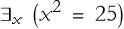 means “there exists an x such that x squared equals 25”).
Term/Definition 11.19 ForAll[] (Wolfram Language function): A symbolic representation of the universal quantifier (∀); used to express “for all” statements.
Term/Definition 11.20 Exists[] (Wolfram Language function): A symbolic representation of the existential quantifier (∃); used to express “there exists” statements.
Assumptions (the implicit beliefs the author relies on)
Assumption 11.12: The universal quantifier ∀ applies to every object under consideration; the existential quantifier ∃ applies to at least one.
Principles
Principle 11.15 Universal quantifier (∀ or ForAll): “for all x, P(x)” is true only if P holds for every x.
Principle 11.16 Existential quantifier (∃ or Exists): “there exists an x such that P(x)” is true if P holds for at least one x.
Exercise 11.8: Begin with Term/Definition 11.12 and copy it into your notebook. Reflect on its meaning for a few minutes. Note any thoughts that come to mind. How would you explain this to someone sitting in front of you. Write this down. Then do this for each term/definition, assumption, and principle.
Exercise 11.9:
a) Write three predicates based on the property “x has a velocity greater than 0 m  ” for different objects (e.g., a car, a planet, a particle). For each, decide if it’s true or false in a specific scenario (e.g., a parked car). Hint: Define x clearly for each case.
b) Construct a statement using ∀x with the predicate “x accelerates at 9.8 m  in free fall” and determine if it’s true for all objects near Earth’s surface. Provide a counterexample if false. Hint: Consider air resistance or altitude.
c) Create a statement using ∃x with the predicate “x has zero kinetic energy” and give a physics scenario where it’s true (e.g., a stationary object). Explain why it might not hold for all cases. Hint: Think of a system at rest.
d) Write a statement using both ∀x and ∃y with predicates “x is a planet” and “y orbits x,” such as ∀x ∃y (x is a planet⇒y orbits x). Verify its truth with a solar system example. Hint: Check each planet.
e) Use the Wolfram Language to test the statement  with ForAll[x, x > 0,
  > 0] and
 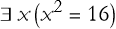 with Exists[x,
  == 16]. Interpret the results in a physics context (e.g., positive energy values).
Axiomatic Systems
Picture yourself building a bridge. You wouldn’t just toss materials together and hope it stands—you’d start with a solid foundation and a clear set of rules to guide the construction. In mathematics and physics, we take a similar approach when we tackle new problems or develop fresh ideas. We begin with a handful of basic assumptions—truths we accept without proof—and use them to build a logical framework for everything else. This method, which we call an axiomatic system, acts like the blueprint for our reasoning, providing a sturdy base to derive laws, solve equations, and even invent new physics.
The most fundamental object in any axiomatic system is, reasonably enough, a collections of assumptions that we consider to be true (based on experience or measurement). As stated above we call these axioms, they are sometimes called postulates. These are the starting point.
An important component is to assign a collection of words that describe a technical term. We call this collection of words, when it describes an idea, a definition for the technical term associated with the idea. Clear definitions are an important part of any system. It allows us to know we are talking about the same thing. There is a subtle requirement; we cannot use the term in its definition. It is possible to have a situation where a collection of definitions will begin to reference the terms you are trying to define. We call these circular definitions. They are not allowed. For this reason, there are some terms that we cannot define exactly—we can only have a vague understanding of them—these are called undefined terms. Of course, we want to keep such primitive notions to as few as possible. In some ways these are the definitional analogy to axioms, we simply assume that we understand what they mean. While definitions are important, there is nothing that we can do with them. They are flat facts. If we had a complete list of all definitions of math and physics, they would take up a lot of space; but it would not tell us how to do anything.
There is a third element in axiomatic systems, these are specific instructions for how to make logical arguments. We call them rules of inference.
I1: Modus Ponens (Affirming the Antecedent): If we have a statement “If P, then Q” (P ⇒ Q) and we know P is true, we can conclude Q is true.
I2: Modus Tollens (Denying the Consequent): If “If P, then Q” is true and Q is false, we can conclude P is false.
I3: Hypothetical Syllogism: If “If P, then Q” and “If Q, then R” are true, we can conclude “If P, then R.”
I4: Disjunctive Syllogism: If “P or Q” is true and P is false, we can conclude Q is true (or vice versa if Q is false).
I5: Addition: If P is true, we can conclude “P or Q” is true for any statement Q.
I6: Simplification: If “P and Q” is true, we can conclude P is true (and similarly for Q).
I7: Commutativity of And: P ∧ Q is the same as Q ∧ P.
I8: Commutativity of Or: P ∨ Q is the same as Q ∨ P.
I9: DeMorgan’s Rule for the Negation of a Conjunction: The negation of a conjunction (P ∧ Q) is equivalent to the disjunction of the negations of the individual components. ¬(P∧Q)~¬P∨¬Q.
I10: DeMorgan’s Rule for the Negation of a Disjunction: The negation of a disjunction (P ∨ Q) is equivalent to the conjunction of the negations of the individual components. ¬(P∨Q)~¬P∧¬Q.
I11: Complementation 1: P ∧ ¬P is always false.
I12: Complementation 2: P ∨ ¬P is always true.
I13: Double Negative: ¬(¬P) ~P.
I14: Excluded Middle: P ∨ ¬P.
Formal Definitions
Definition 11.1 Axiom (or postulate): A statement accepted as true without proof; the starting point of an axiomatic system.
Definition 11.2 Definition: A precise description of a technical term using previously established terms and undefined primitives, without circularity.
Definition 11.3 Circular definition: An invalid definition that uses the term being defined (or creates a loop among terms)—not permitted.
Definition 11.4 Rule of inference: A precise, mechanical instruction for deriving new statements from existing ones while preserving truth.
Axioms
Axiom 1.1: There exist basic, primitive, notions that cannot be defined without circularity and must be accepted intuitively.
Axiom 1.2: Every formal definition must use only previously defined or undefined terms; no term may appear in its own definition.
Axiom 1.3: Axioms are accepted as true without proof; they form the secure foundation for all subsequent reasoning.
Axiom 1.4: The listed 14 rules of inference (I1–I14) are sufficient to derive all valid logical conclusions in classical reasoning.
Principles
Principle 11.17 Modus Ponens (I1): If P ⇒ Q and P, then Q.
Principle 11.18 Modus Tollens (I2): If P ⇒ Q and ¬Q, then ¬P.
Principle 11.19 Hypothetical Syllogism (I3): If P ⇒ Q and Q ⇒ R, then P ⇒ R.
Principle 11.20 Disjunctive Syllogism (I4): If P ∨ Q and ¬P, then Q.
Principle 11.21 Addition (I5): If P, then P ∨ Q (for any Q).
Principle 11.22 Simplification (I6): If P ∧ Q, then P (and Q).
Principle 11.23 Commutativity of And (I7): P ∧ Q ⇔ Q ∧ P.
Principle 11.24 Commutativity of Or (I8): P ∨ Q ⇔ Q ∨ P.
Principle 11.25 DeMorgan's Conjunction (I9): ¬(P ∧ Q) ⇔ ¬P ∨ ¬Q.
Principle 11.26 DeMorgan's Disjunction (I10): ¬(P ∨ Q) ⇔ ¬P ∧ ¬Q.
Principle 11.27 Complementation 1 (I11): P ∧ ¬P is always false (this is a contradiction).
Principle 11.28 Complementation 2 (I12): P ∨ ¬P is always true (this is also called the law of excluded middle).
Principle 11.29 Double Negation (I13): ¬(¬P) ⇔ P.
Principle 11.30 Excluded Middle (I14): P ∨ ¬P is always true.
Principle 11.31 Minimal foundation: Start with as few axioms and undefined terms as possible; build everything else from them.
Principle 11.32 Non-circularity: Definitions must avoid circularity — no term may define itself.
Exercise 11.10: Begin with Definition 11.1 and copy it into your notebook. Reflect on its meaning for a few minutes. Note any thoughts that come to mind. How would you explain this to someone sitting in front of you. Write this down. Then do this for each definition, axiom, and principle.
Conjecture
Have you ever watched a pattern unfold—like how a ball seems to slow down on grass but keeps rolling on ice—and wondered if there’s a rule behind it? In physics and mathematics, when we spot something that looks true based on what we’ve seen so far, we often make an educated guess about it. This idea, which we call a conjecture, is like a hunch we test with examples and logic, hoping to turn it into a solid fact. It’s the spark that starts us down the path of discovery, even if we cannot accept it as a fact.
Think about how physicists might notice that objects falling from specific heights seem to hit the ground at the same time when air resistance is low, regardless of how much they weigh. You might guess, “Maybe all objects fall at the same rate regardless of mass!” That’s a conjecture—a statement we suspect is true based on observation, like Galileo’s early ideas about gravity. In math, a conjecture might be something like “Every even number greater than 2 can be written as the sum of two prime numbers” (this is called the Goldbach Conjecture), which we test with examples but haven’t fully proven. In physics, conjectures often lead to laws, but they start as testable predictions.
To explore these hunches, we can use the Wolfram Language to check patterns. For instance, try Table[2 n, {n, 2, 10}] to list even numbers like 4, 6, 8, and test if they’re sums of primes (e.g., 4 = 2 + 2, 6 = 3 + 3), or use Select[Range[1, 10], # < 5 &] to see which numbers are less than 5 and match a property. These tools let you gather evidence to support or challenge your conjecture. The catch? A conjecture isn’t proven until we build a logical argument—something we’ll tackle in the next sections on proofs. By getting comfortable with conjectures, you’re learning to ask “What if?” and test it, setting the stage for the breakthroughs that shape both mathematics and theoretical physics!
Exercise 11.11:
a) Watch a ball roll on different surfaces (e.g., carpet vs. tile) and note how its speed changes. Form a conjecture about how the surface type affects stopping time. Hint: Look for consistent trends.
b) Based on dropping two objects of different weights (e.g., a feather and a coin in a vacuum), conjecture whether mass affects fall time. Write your guess as a statement. Hint: Recall the falling objects example.
c) For the conjecture “All odd numbers are the sum of a prime and 1,” test it with the first five odd numbers (3, 5, 7, 9, 11). Record your findings. Hint: Check each case manually.
d) Use Table[2 n, {n, 2, 10}] to list even numbers and test the Goldbach Conjecture (every even number > 2 as a sum of two primes) for 4, 6, 8, and 10. Note any counterexamples. Hint: Try pairs like 3 + 3 for 6.
e) Observe a toy car on a ramp with varying slopes. Conjecture whether steeper slopes always increase speed. Test with two slopes and explain your result. Hint: Measure distance and time.
f) Start with the conjecture “All objects float on water.” Test it with a rock, a leaf, and a cork, then refine it based on your observations. Hint: Adjust for density or material.
g) Notice that squares of integers (1, 4, 9, 16) increase by odd numbers (3, 5, 7). Conjecture a rule for the difference between consecutive squares. Test with  and
and  . Hint: Look at the pattern.
h) Use Select[Range[1, 20], EvenQ[#] && # > 2 &] to list even numbers > 2, then manually check if each can be a sum of two primes (e.g., 12 = 5 + 7). Form a conjecture based on your results. Hint: Run the command first.
i) Hypothesize whether a pendulum’s swing time depends on its weight. Test with two different masses (e.g., using a string and weights) and record your observations. Hint: Time several swings.
j) After dropping objects and rolling a ball, conjecture a general rule about how gravity affects motion on flat vs. inclined surfaces. Support with two examples. Hint: Compare fall time and roll distance.
Direct Proofs
What if you noticed that pushing a cart harder seems to make it speed up more, and you guessed, “If I double the force on a cart whose mass remains the same, its acceleration doubles too”? As we saw in the previous section, that’s a conjecture. The next step is to turn that guess into a fact that we can trust, and one of the most direct ways to do this is by building a clear, step-by-step argument from what we already know. We call this method direct proof, is like following a straight path from established truths (like axioms or definitions) to show that your conjecture holds true every time.
This is at once the most effective proof and the most difficult. Here are the steps:
State the hypothesis.
Make your first argument in a sequence that will bring you to the conclusion.
: (this symbol indicates a variable number of steps). You may use axioms, technical terms, definitions, rules of inference, or previously established theorems (conjectures that are already proven).
Make you final argument.
State your conclusion.
Often this process is ended by writing Q.E.D. standing for qoud erat demonstrandum, meaning roughly, "Which was to be demonstrated."
To prove the conjecture we proposed above directly, we start with Newton’s second law, which states that force equals mass times acceleration,

(11.1)
Let’s define acceleration as the rate of change of velocity and assume the mass stays constant. Our hypothesis is that the force doubles—from, say, F to 2 F—and mass m doesn’t change. We can reason that
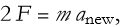
(11.2)
where  is the new acceleration. Dividing the (11.2) by the 11.1 gives
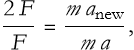
(11.3)
simplifying to
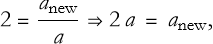
(11.4)
From this we see that the acceleration doubles! This is our conclusion. This logical chain holds for all cases with constant mass, so our conjecture becomes a theorem—a proven statement that we can rely on.
Undefined Terms
Term 11.1 Conjecture: An educated guess or proposed statement suspected to be true based on observation, examples, patterns, or intuition, but not yet proven.
Term 11.2 Q.E.D.: Latin abbreviation for “Quod Erat Demonstrandum” (“which was to be demonstrated” or “that which was to be shown”); traditionally placed at the end of a proof to indicate completion.
Formal Definitions
Definition 11.5 Theorem: A statement proven true using logical deduction from accepted truths (axioms, definitions, prior theorems).
Definition 11.6 Hypothesis: The “If” part of a statement to be proved.
Definition 11.7 Conclusion: The “Then” part of a statement to be proved.
Definition 11.8 Direct proof: A step-by-step logical argument that starts from the hypothesis, uses known truths and rules of inference, and arrives at the conclusion without contradiction or indirect methods.
State the hypothesis.
Present a sequence of logical steps using axioms, definitions, prior theorems, and rules of inference.
Reach the conclusion.
End with Q.E.D. or □ to mark completion.
Axioms
Axiom 1.5: Newton’s Second Law (treated as an accepted physical axiom here): F = m a (force equals mass times acceleration) — used as a starting truth for the direct proof example.
Axiom 1.6: Mass is constant (in the given context): Assumed true for the direct proof example.
Axiom 1.7: Acceleration is the rate of change of velocity (accepted definition/axiom in mechanics).
Axiom 1.8: Logical deduction preserves truth: If premises are true, conclusions derived via valid rules are true.
Principles
Principle 11.33: Conjectures become theorems via proof: A conjecture is elevated to a theorem once a rigorous logical argument establishes its truth.
Principle 11.34: Direct proof is the most straightforward method.
Principle 11.35: Logical steps must be reversible and truth-preserving: Each step follows from prior truths via valid inference.
Principle 11.36: Verification is essential: Proofs must be checked for correctness; conclusions must follow logically.
Principle 11.37: Physics conjectures often become laws: Observations (e.g., objects fall at same rate) lead to conjectures, then proofs, then accepted laws.
Principle 11.38: Direct proof is powerful but challenging: It requires clear reasoning and deep understanding of foundations.
Principle 11.39: Conjectures spark discovery: They encourage “What if?” thinking.
Exercise 11.12: Begin with Term 11.1 and copy it into your notebook. Reflect on its meaning for a few minutes. Note any thoughts that come to mind. How would you explain this to someone sitting in front of you. Write this down. Then do this for each term, definition, axiom, and principle.
Exercise 11.13:
a) State a conjecture about motion, such as “If an object’s mass doubles and the force remains the same, its acceleration halves.” Use Newton’s second law to outline the first step of a direct proof. Hint: Start with F=m a.
b) Prove the conjecture “If the net force is zero, the object’s velocity is constant” using a direct proof. Include all five steps and end with Q.E.D. Hint: Use Newton’s first law as the axiom.
c) For the conjecture “If force triples and mass stays constant, acceleration triples,” perform a direct proof. Show at least two intermediate steps before the final argument.
d) Conjecture that “If an object slides on a frictionless surface with constant force, its velocity increases linearly with time.” Use Newton’s second law and define velocity change to prove it, ending with Q.E.D. Hint: Relate force to a rate of change.
e) Prove the conjecture “If the mass is halved and force doubles, acceleration quadruples” with a direct proof, including three intermediate steps. Hint: Use F=m a and manipulate the ratios.
f) Conjecture that “If force is proportional to velocity and mass is constant, acceleration depends on velocity.” Perform a direct proof with at least two steps. Hint: Express F=k v and derive a.
g) Prove the conjecture “If the net force equals the product of mass and a constant acceleration, the object accelerates at that rate” using a direct proof. Include all steps and Q.E.D.
h) Use the conjecture “If force is zero, acceleration is zero” and test it with Resolve[Implies[force == 0, acceleration == 0], Reals] in Wolfram Language. Then, write a direct proof with three steps to confirm it, ending with Q.E.D. Hint: Use Newton’s first law.
i) Conjecture that “If an object’s initial velocity is zero and a constant force acts, its displacement increases with the square of time.” Prove it directly using Newton’s second law and kinematics, with at least three steps and Q.E.D. Hint: Derive  .
.
Proof by Contrapositive
The contrapositive (¬q⇒¬p) and the conditional (p⇒q) are logically equivalent, thus if we can prove the contrapositive, we have proven the conditional. We begin this method of proof by stating the conclusion.
State the conclusion q.
Write the negation of the conclusion, ¬q.
Make your first argument in a sequence that will bring you to the hypothesis.
:.
Make your final argument.
State the negation of the hypothesis, ¬p.
Make the argument that by the contrapositive the conditional must be true, p⇒q. Q.E.D.
Let’s take a conjecture from physics: “If an object is at rest, then no net force is acting on it.” This is a conditional statement where p is “the object is at rest” and q is “no net force is acting.” Since the contrapositive (¬q ⇒ ¬p) is logically equivalent, we’ll prove “If a net force is acting (¬q), then the object is not at rest (¬p)” to establish the original statement. Here’s the step-by-step proof:
State the conclusion: The conclusion is “no net force is acting (q).”
Write the negation of the conclusion: The negation is “a net force is acting (¬q).”
Make your first argument in a sequence that will bring you to the hypothesis: If a net force is acting (¬q), we turn to Newton’s first law, which states that an object remains at rest or moves at constant velocity unless acted upon by a net force. A net force suggests a change is possible.
Consider what a net force does. Newton’s second law (F=m a) tells us that a net force causes acceleration, which is a change in velocity.
Make your final argument: If the object is accelerating due to the net force, it cannot be at rest (since rest means zero velocity and no change).
State the negation of the hypothesis: This leads to “the object is not at rest (¬p).”
Make the argument that by the contrapositive the conditional must be true: Since we’ve shown ¬q ⇒ ¬p (if a net force acts, the object isn’t at rest), and the contrapositive is equivalent to the original p ⇒ q (if the object is at rest, no net force acts), the conjecture holds.
Thus, Q.E.D.
Formal Definitions
Definition 11.9 Proof by contrapositive: A direct proof method where one proves the contrapositive ¬Q ⇒ ¬P instead of the original P ⇒ Q; since they are equivalent, proving one proves the other.
Axioms
Axiom 1.9 Newton’s First Law (treated as an accepted physical axiom): An object at rest or in uniform motion remains so unless acted upon by a net force.
Principles
Principle 11.40: Proof by contrapositive is a direct proof method: Prove the equivalent statement ¬Q ⇒ ¬P to establish the original P ⇒ Q.
Structure of proof by contrapositive: State the conclusion Q.
Negate it: ¬Q.
Prove from ¬Q to ¬P (using axioms, definitions, prior theorems, inference rules).
State the negation of the hypothesis: ¬P.
Conclude: since ¬Q ⇒ ¬P is proven and equivalent to P ⇒ Q, the original holds.
End with Q.E.D. or □.
Exercise 11.14: Begin with Definition 11.9 and copy it into your notebook. Reflect on its meaning for a few minutes. Note any thoughts that come to mind. How would you explain this to someone sitting in front of you. Write this down. Then do this for each definition, axiom, and principle.
Exercise 11.15:
a) State the conclusion for the conjecture, “If an object accelerates, then a net force acts on it.”
b) Prove the conjecture “If an object is at rest, then no net force acts” using proof by contrapositive.
c) For the conjecture “If an object’s acceleration is zero, then the net force is zero,” perform a proof by contrapositive with at least two intermediate steps.
d) Prove the conjecture “If a constant force acts, then the object’s velocity changes” using proof by contrapositive.
e) Prove the conjecture “If an object moves at constant velocity on a frictionless surface, then no net force acts” using proof by contrapositive.
f) For the conjecture “If mass is constant and acceleration doubles, then force doubles,” perform a proof by contrapositive with two intermediate steps.
g) Prove the conjecture “If velocity is constant, then no net force acts” using proof by contrapositive.
h) Use the conjecture “If an object doesn’t accelerate, then no net force acts” and test it with Resolve[Implies[Not[acceleration > 0], Not[force > 0]], Reals] in Wolfram Language. Then, write a proof by contrapositive.
i) Conjecture that “If the net force is nonzero, then the object’s position changes over time.” Prove it by contrapositive.
Proof by Contradiction (Reductio Ad Absurdum)
In this method of proof, you assume the negation of the hypothesis, show that it leads to a contradiction, thus showing that the negation cannot be true.
State the hypothesis.
Assume that the hypothesis implies the negation of the conclusion
Make your first argument in a sequence that will bring you to the conclusion.
:.
Make you final argument.
Show that this implies that the negation of the conclusion is both true and false, such a situation is always false.
Since this a contradiction, the negation of the conclusion cannot be true.
The conclusion must then be true. Q.E.D.
The ancient Greek philosophers had the mistaken idea that gravitation was a natural tendency for objects to be attracted to an almost mystical place in the world. This special place was the center of the Earth. The heavier an object was the more strongly attracted it would be to that center. In other words, their weight determined their proper place and they all settled into that place. This was their idea of gravity. Today scientists laugh at that idea, but what tells us that this idea is wrong?
The fact that Aristotle’s idea of gravity was wrong took a long time to be realized. It was Galileo that put the proverbial “nail in the coffin.” His argument went something like this:
We will assume that an object that is heavy falls faster than a lighter object as they are each trying to get to their proper place in the world. This explained why it was possible to pick up small objects, but not buildings or mountains; the latter being in their proper places. This is the idea promoted by Aristotle.
What happens when we strap a lighter object to a heavy one? There are two possibilities; either the combined object acts like a single object, or it does not. This idea is an example of modus ponens. Something either is or it is not, there is no middle. These possibilities led to the next two arguments.
If the combination forms a single object, that single object is heavier than either of the two components. By the assumption in step 1 the single heavier object must fall faster than the heavier of the two component objects.
If the combination does not form a composite object, then, by the assumption made in step 1, the lighter object will fall slower than the heavier. Since they are connected by the strap, the lighter object will slow the rate of fall of the heavier object, so the combination will not fall as fast as the heavier object.
These arguments lead to the prediction that the same combination of objects fall both faster and slower than the heavier of the two component objects. A situation where a given assertion leads to two or more opposing outcomes is called a contradiction. No assertion that leads to a contradiction can be true.
In this case we have proved that Aristotle's assertion that objects fall at a rate according to their weight is false; this is the same as proving that objects fall in a way that is independent of their weight. In fact, this principle is the law of falling bodies. To state this law explicitly, objects fall under the influence of gravity independent of their weight. This implies that the influence of gravity is the same for all objects.
Formal Definitions
Definition 11.10 Proof by contradiction (or reductio ad absurdum): A method of proof where one assumes the negation of the statement to be proven, derives a contradiction from it, and concludes that the original statement must be true (since its negation is impossible).
Axioms
Axiom 11.10 Observations as axioms (in the example): Heavier objects fall faster than lighter ones (Aristotle’s assumption, taken as true for contradiction).
Axiom 11.11 Law of falling bodies: The principle that objects fall under gravity independent of their weight (proven by Galileo’s contradiction of Aristotle’s view).
Principles
Principle 11.41: Proof by contradiction is a indirect proof method
Assume the negation: Start by assuming the opposite of what you want to prove (assume ¬Q if proving P ⇒ Q).
Make arguments leading to contradiction.
State the contradiction (true and false).
Conclude negation cannot be true.
Thus original (conclusion Q) is true.
End with Q.E.D. or □.
Exercise 11.16: Begin with Definition 11.10 and copy it into your notebook. Reflect on its meaning for a few minutes. Note any thoughts that come to mind. How would you explain this to someone sitting in front of you. Write this down. Then do this for each definition, axiom, and principle.
Exercise 11.17:
a) Restate Galileo’s proof by contradiction in your own words, focusing on the logical structure. Identify the hypothesis, the assumption of its negation, the contradiction, and the conclusion. Why does the contradiction prove that Aristotle’s idea is false?
b) Write out the steps of Galileo’s proof by contradiction as a formal logical argument, using the structure provided in the book (hypothesis, negation, sequence of arguments, contradiction, conclusion). Label each step clearly, and explain how the contradiction arises from the assumption that heavier objects fall faster.
c) Imagine you are Galileo, and you need to convince a skeptic that objects fall at the same rate regardless of weight (ignoring air resistance). Design a thought experiment, similar to the strapped objects, that leads to a contradiction if Aristotle’s theory is assumed. Describe the setup, assumptions, and how the contradiction arises.
d) Use proof by contradiction to show that the acceleration due to gravity cannot depend on an object’s shape (assuming no air resistance). Assume that objects of different shapes (e.g., a sphere and a cube) fall at different rates, and derive a contradiction. Hint: Consider objects made of the same material and weight but different shapes.
e) Galileo is said to have dropped objects from the Leaning Tower of Pisa to demonstrate that objects fall at the same rate. Suppose you conduct an experiment with two objects of different weights (e.g., a 1 kg ball and a 5 kg ball) dropped from a height of 10 meters in a vacuum. Using the equation for free fall,  , calculate the time it takes for both objects to hit the ground (assume g=9.8 m
  ). Does the result support Galileo’s conclusion? Why or why not?
f) A supporter of Aristotle’s theory argues that heavier objects fall faster because they have a greater “desire” to reach the Earth’s center. Use proof by contradiction to refute this claim by constructing a scenario (similar to Galileo’s strapped objects) that leads to a logical inconsistency. Explain each step of your reasoning.
g) In real-world conditions, air resistance affects falling objects. Suppose Aristotle’s theory is modified to claim that heavier objects fall faster in air because they overcome air resistance more effectively. Design a proof by contradiction to show that this modified theory still leads to a contradiction if it assumes fall rate depends solely on weight. Hint: Consider objects of different weights but identical shapes and sizes.
h) Assume Aristotle’s theory implies that the speed of a falling object is proportional to its weight. If we consider v as velocity, m for mass, and a constant k, so v=k m v. Using Galileo’s strapped-object thought experiment, show mathematically that this assumption leads to a contradiction. Define the masses of the two objects (e.g.,  and
and  , with
  ) and derive the conflicting speeds for the composite object.
i) Galileo’s conclusion implies that all objects fall at the same rate in a vacuum. Extend this idea to a different physical context: suppose someone claims that on the Moon (where there is no atmosphere), objects fall at rates proportional to their density. Use proof by contradiction to show this claim is false. Hint: Consider combining objects of different densities but similar behavior in free fall.
Problem 11.18: Research a brief historical account of how Galileo’s experiments and reasoning impacted the scientific understanding of gravity (you can use web or X posts for this if needed). Then, write a short proof by contradiction to refute another ancient belief, such as the idea that the Earth is the center of the universe (geocentrism). Assume the Earth is the center, and derive a contradiction using observations like planetary retrograde motion.
Constructing Proofs
Having explored direct proofs, contrapositive proofs, and proofs by contradiction, we now turn to the broader process of constructing proofs. Proofs are the backbone of mathematics and mathematical physics, providing a rigorous way to establish truths and uncover the principles governing natural phenomena, such as Galileo’s refutation of Aristotle’s gravity theory. Constructing a proof is both a logical and creative endeavor, requiring you to choose the right strategy, connect assumptions to conclusions, and ensure clarity. This section outlines general strategies for building proofs, introduces proof by cases as an additional technique, and illustrates their application in mathematical physics.
General Strategies for Constructing Proofs
When tasked with proving a statement—typically of the form "If P, then Q" (where P is the hypothesis and Q is the conclusion)—start by clearly defining the problem and selecting an appropriate method. Here are key strategies to guide you:
Analyze the Statement: Dissect the hypothesis P and conclusion Q. Identify relevant definitions, theorems, or physical principles. Ask: What do I know? What must I show? Are there counterexamples that challenge the statement?
Work Backwards: Begin with the conclusion Q and consider what conditions imply it. Trace back through logical steps until you connect to P or known facts. This can reveal a path to follow in a forward proof.
Choose the Right Method:
Direct Proof: Assume P and derive Q through logical steps, such as algebraic manipulations or applying physical laws (e.g., Newton’s laws for motion).
Contrapositive Proof: Prove "If not Q, then not P" if the negation simplifies the logic, especially for inequalities or non-existence claims.
Proof by Contradiction: Assume P and not Q, then derive a contradiction, as Galileo did to disprove Aristotle’s weight-dependent fall rates.
Break into Cases: If P can be split into distinct scenarios (e.g., positive vs. negative values), prove Q for each case separately to cover all possibilities.
Leverage Physical Intuition: In physics, use thought experiments or diagrams to visualize the problem. Clearly state idealizations (e.g., no air resistance) to align with physical models.
Ensure Logical Clarity: Conclude with Q.E.D. (“which was to be demonstrated”) or a box (□) to signal completion. Double-check for gaps in reasoning or unstated assumptions.
Proof construction often involves trial and error. If one method stalls, pivot to another, such as switching from direct to contradiction.
Additional Proof Technique: Proof by Cases
Proof by cases is effective when the hypothesis naturally divides into mutually exclusive scenarios, each requiring separate proof of the conclusion. This method ensures all possibilities are covered, making it useful in physics for problems with discrete conditions (e.g., motion under different forces).
For example, we can prove that the gravitational potential energy,

(11.5)
is non-negative for any object above a reference point h ≥ 0.
Case 1 (h > 0): Since m > 0 (mass is positive) and g > 0 (a constant, e.g., 9.8 m  ), U=m g h>0.
Case 2 (h = 0): U=m g⋅0=0, which satisfies U≥0.
Since h < 0 is not allowed (height is measured above the reference), all cases are covered. Thus, U≥0, . Q.E.D.
This mirrors physical scenarios where energy must be non-negative relative to a chosen zero point.
Applying Proofs in Physics
In physics, proofs combine mathematical logic with empirical principles. Consider extending Galileo’s proof by contradiction to a related claim: Suppose someone asserts that gravitational acceleration g depends on an object’s density ρ. To disprove this:
Hypothesis: All objects fall at the same rate under gravity (g is constant).
Negation: Assume g = k/ρ for some constant k, so denser objects fall slower.
Argument: Strap two objects of masses  and
and  and densities
  and
and  where
where  and
and  . If they form a single object, the composite density yields a new g, but individually, the denser object falls slower, leading to conflicting fall rates (as in Galileo’s argument).
Contradiction: The composite falls both faster and slower than the denser object.
Conclusion: g cannot depend on ρ; it is constant. Q.E.D.
This reinforces the law of falling bodies, showing gravity’s uniformity across material properties.
Common Pitfalls and Tips
Avoid Circular Reasoning: Don’t assume Q while proving it.
Clarify Quantifiers: Specify "for all" (∀) or "there exists" (∃) to avoid ambiguity.
State Physical Assumptions: In physics, note idealizations (e.g., vacuum conditions).
Test with Examples: Use specific values to check intuition but ensure general proof.
Practice Contradictions: Disprove false claims (e.g., Aristotle’s gravity) to hone skills.
Conclusion
Constructing proofs requires selecting the right method—direct, contrapositive, contradiction, or cases—based on the problem’s structure. In physics, these methods clarify fundamental laws, as seen in Galileo’s work. By practicing these strategies, you’ll develop the ability to prove statements rigorously and apply them to physical phenomena.
Formal Definitions
Definition 11.11 Proof by cases: A method that splits the hypothesis into distinct, exhaustive cases and proves the conclusion in each case.
Principles
Principle 11.42: Choose the right method: Select direct, contrapositive, contradiction, or cases based on the statement's structure and ease of proof.
Principle 11.43: Analyze the statement: Dissect hypothesis (P) and conclusion (Q); identify relevant axioms, definitions, theorems, or physical principles.
Principle 11.44: Work backwards: Start from the conclusion and trace back to the hypothesis — can reveal the best path.
Principle 11.45: Use physical intuition: Visualize with thought experiments or diagrams; state idealizations (e.g., no air resistance).
Principle 11.46: Ensure logical clarity: Each step must follow from prior truths via valid inference; avoid gaps or unstated assumptions.
Principle 11.47 Proof by cases: Split hypothesis into mutually exclusive scenarios; prove conclusion in each case to cover all possibilities.
Principle 11.48 Common pitfalls: Circular reasoning, unstated assumptions, unclear quantifiers (for all vs. exists).
Principle 11.49: Proof construction is creative and iterative: Try methods, pivot if stuck, refine reasoning.
Exercise 11.19: Begin with Definition 11.11 and copy it into your notebook. Reflect on its meaning for a few minutes. Note any thoughts that come to mind. How would you explain this to someone sitting in front of you. Write this down. Then do this for each definition, and principle.
Exercise 11.20:
a) Prove that the kinetic energy of an object, is always non-negative for any real velocity v. Use a direct proof, starting with the definition of kinetic energy and properties of real numbers. Clearly state the hypothesis and conclusion.
b) Prove the statement: “If an object is in motion, then a net force acts on it.” Use a contrapositive proof by showing that if no net force acts, the object is not in motion.
c) Use proof by contradiction to show that gravitational acceleration does not depend on an object’s shape. Assume that objects of the same mass but different shapes (e.g., a sphere and a flat sheet) fall at different rates in a vacuum. Derive a contradiction by considering a composite object made by combining the two shapes.
d) Prove the statement: “If two objects of different masses take different times to fall from the same height in a vacuum, then they are not under the same gravitational acceleration.” Use a contrapositive proof to show that if they experience the same gravitational acceleration, their fall times are equal.
e) Suppose Aristotle’s theory is modified to claim that objects fall faster in a denser medium (e.g., water) based on their weight. Use proof by contradiction to disprove this by assuming heavier objects fall faster in a medium, and consider two objects strapped together. Show that the composite object’s fall rate leads to a contradiction, as in Galileo’s argument.
f) Prove the the force due to gravitation is always attractive.
g) Suppose someone claims that the rate of free fall depends on an object’s material composition (e.g., wood vs. metal). Use proof by contradiction to show this is false. Assume two objects of different materials but equal mass fall at different rates in a vacuum. Derive a contradiction by considering a composite object made of both materials strapped together.
Logical Analysis
Logical analysis is the process of dissecting mathematical and physical statements to uncover their structure, identify assumptions, and evaluate their validity. In mathematical physics, this skill is essential for constructing proofs, interpreting physical laws, and challenging incorrect theories, such as Aristotle’s weight-dependent gravity model refuted by Galileo. By analyzing statements logically, we ensure that proofs—whether direct, contrapositive, by contradiction, or by cases—are built on a solid foundation. This section introduces tools for logical analysis, including propositional logic, quantifiers, and logical equivalences, and demonstrates their application in physics.
Steps in Logical Analysis
Identify Components: Break the statement into propositions, connectives, and quantifiers. For example, Galileo’s hypothesis, “All objects fall at the same rate in a vacuum,” is a universal statement (∀) with the proposition “fall rate is constant.”
Translate to Logical Form: Express the statement using symbols. For Galileo: ∀ objects x∧y, if x and y are in a vacuum, then their acceleration is that of the acceleration due to gravity.
Test Logical Structure: Check if the statement is an implication, conjunction, etc. Determine if it’s universal or existential. Identify assumptions (e.g., no air resistance).
Evaluate Implications: Consider the statement’s truth value. What would disprove it? For Galileo, a counterexample would be two objects falling at different rates.
Apply to Proof Methods: Use the analysis to choose a proof strategy
Galileo’s Argument
Consider Galileo’s proof by contradiction refuting Aristotle’s claim that heavier objects fall faster. Let’s analyze it logically:
Statement: ∀ objects x∧ y, if x is heavier than y, then x falls faster than y (Aristotle’s claim).
Negation (Galileo’s Hypothesis): ∃ objects x∧ y such that x is heavier but falls at the same rate as y.
Logical Form: Let P(x,y)=x is heavier than y. Q(x,y)=x falls faster than y. ∀ x∧y P(x,y)⇒Q(x,y). Galileo assumes ∃x∧y P(x,y)⇒¬Q(x,y).
Analysis: Galileo assumes P (heavier object) and ¬Q (falls at same rate), straps objects together, and shows a contradiction (composite falls both faster and slower). This uses modus ponens (if P ⇒ Q, and P, then Q) and contradiction to reject Aristotle’s claim.
This analysis reveals the logical structure: universal quantifier, implication, and contradiction, guiding the proof’s construction.
Common Pitfalls
Ambiguous Quantifiers: Specify ∀ or ∃ clearly (e.g., “all objects” vs. “some objects”).
Misinterpreting Implications: P ⇒ Q does not mean Q ⇒ P. Use contrapositives carefully.
Overlooking Assumptions: In physics, state idealizations (e.g., vacuum conditions).
Practice Logical Translation: Convert physical statements (e.g., “gravity is uniform”) into logical form to clarify proofs.
Test with Counterexamples: Analyze what would falsify a claim to guide contradiction proofs.
Logical analysis equips you to dissect statements, identify their structure, and select the best proof method. In physics, it clarifies the reasoning behind laws, as seen in Galileo’s refutation of Aristotle. By mastering propositions, quantifiers, and equivalences, you’ll build rigorous proofs that illuminate physical truths.
Formal Definitions(precise descriptions given or strongly implied in the section)
Definition 11.12 Logical analysis: The process of breaking down mathematical or physical statements into components (propositions, connectives, quantifiers), identifying assumptions, and evaluating validity.
Exercise 11.21: Begin with Definition 11.12 and copy it into your notebook. Reflect on its meaning for a few minutes. Note any thoughts that come to mind. How would you explain this to someone sitting in front of you. Write this down.
Exercise 11.22:
a) Consider the statement: “All objects in free fall in a vacuum experience the same acceleration due to gravity.” Break this into propositions, connectives, and quantifiers. Identify the hypothesis and conclusion and express it in logical form using symbols. State any assumptions (e.g., vacuum conditions).
b) Translate the statement of Newton’s first law, “An object remains at rest or in uniform motion unless acted upon by a net force,” into logical form. Identify propositions, connectives, and quantifiers. Determine if it’s a universal or existential statement, and suggest a proof method.
c) Analyze the statement: “The gravitational potential energy is non-negative for all objects above the reference point.” Break it into propositions and express it logically. Test its structure: Is it an implication or conjunction? Suggest how proof by cases could be applied, and identify a counterexample that would disprove it.
d) For the statement, “If two objects are dropped from the same height in a vacuum, they hit the ground simultaneously,” identify the hypotheses and the conclusion, and express it in logical form. What would disprove this? Use logical analysis to suggest a proof by contradiction, considering a counterexample where fall times differ.
e) Revisit Galileo’s proof by contradiction refuting Aristotle’s claim that heavier objects fall faster. Rewrite the statement “For all objects x and y, if x is heavier than y, then x falls faster than y” in logical form. Analyze the negation and explain how Galileo’s strapped-object thought experiment uses modus ponens to reach a contradiction.
f) Analyze the claim: “Gravitational acceleration depends on an object’s composition (e.g., wood vs. metal).” Express it in logical form. Formulate the negation and use logical analysis to set up a proof by contradiction, similar to Galileo’s, assuming two objects of different compositions fall at different rates and deriving a contradiction with a composite object.
g) Suppose someone modifies Aristotle’s theory to claim: “In a medium like water, heavier objects fall faster than lighter ones.” Express this in logical form. Analyze what would disprove it (a counterexample). Set up a proof by contradiction using a strapped-object scenario, and explain how the logical structure guides the contradiction.
FindEquationalProof
Equational proofs establish the truth of statements involving equalities or identities. This is particularly useful when deriving or verifying physical laws, such as conservation of energy or Newton’s laws expressed as equations. Unlike logical proofs that rely on implications or contradictions, equational proofs manipulate equations using axioms and algebraic rules to show equivalence. The Wolfram Language provides a powerful tool, FindEquationalProof, to automate such proofs within an axiomatic framework defined by the command AxiomaticTheory. This section introduces equational proofs, demonstrates their use in physics, and illustrates how FindEquationalProof can verify identities, building on the logical analysis skills from prior sections.
An equational proof demonstrates that one expression equals another by applying axioms (e.g., commutativity, associativity) or physical laws. For example, proving that the total mechanical energy in a closed system is conserved involves showing that the sum of kinetic and potential energy remains constant. In physics, equational proofs are critical for:
Deriving relationships.
Verifying identities.
Simplifying complicated physical models to reveal underlying principles.
The Wolfram Language’s FindEquationalProof automates this by searching for a sequence of transformations from one expression to another, given a set of axioms defined via AxiomaticTheory.
The FindEquationalProof command takes a statement (an equality to prove) and an axiomatic system, often defined using AxiomaticTheory, which specifies the rules (axioms) for manipulating expressions. The general syntax is:


To use this we need to follow some steps:
Define the axioms to be used (this list can also include established definitions and theorems that have been previously proven to be true).
Formulate the theorem you are trying to prove.
Run the command FindEquationalProof. The output will be in the form of a ProofObject. Be sure to assign a label for the proof.
You can see the proof in an easy to follow way writing label[“ProofNotebook”].
Try to verify it.
For example, we can try to prove that if a=b and b=c and c=d (this is included in the documentation from Wolfram Research).



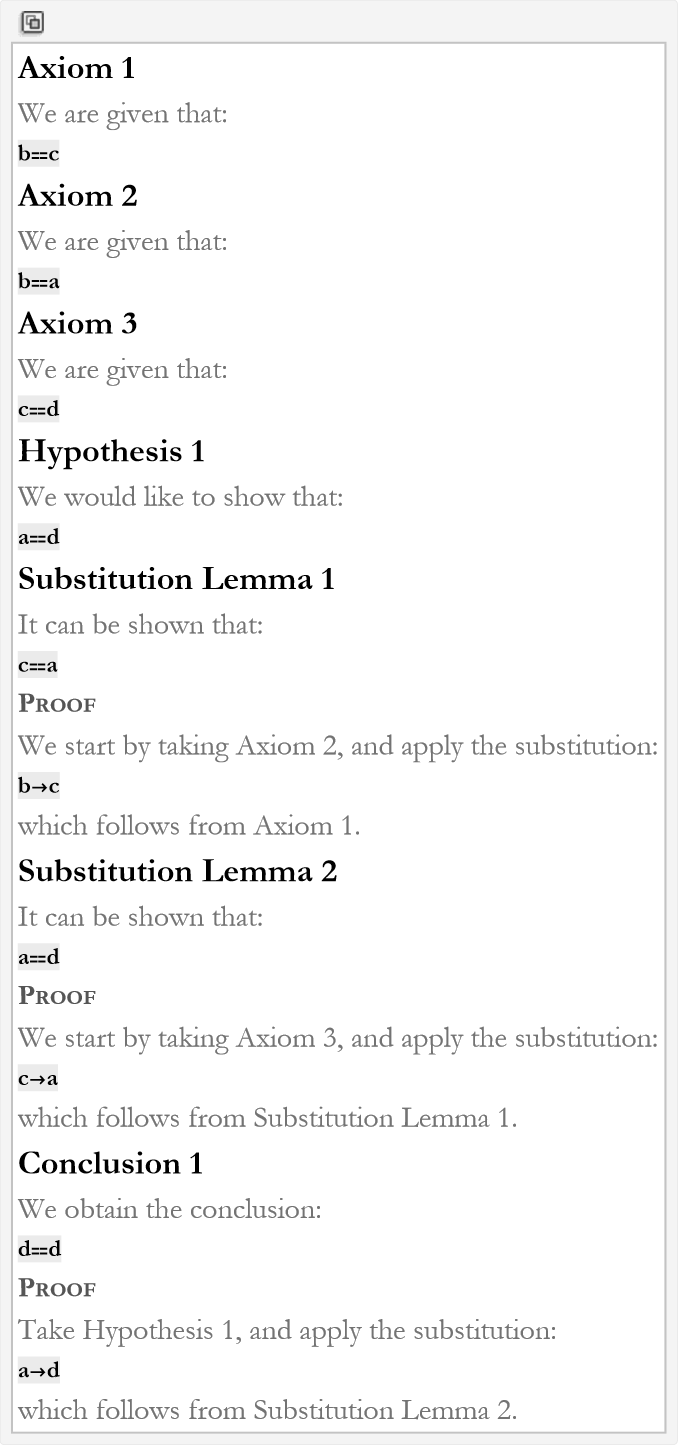
There is a built in theory in the Wolfram Language, that of Boolean Logic, named after the English autodidact George Boole (1815-1864).

So, what do these symbols mean? The letter with a dot beneath it is what we have been calling a proposition (actually it means an abstract object suitable for the theory we are discussing, in logic these are propositions). The ⊗ symbol is and, the ⊕ is or, and the line over the symbol is not. We can see the names of these. WEe can see some of these details in this table.

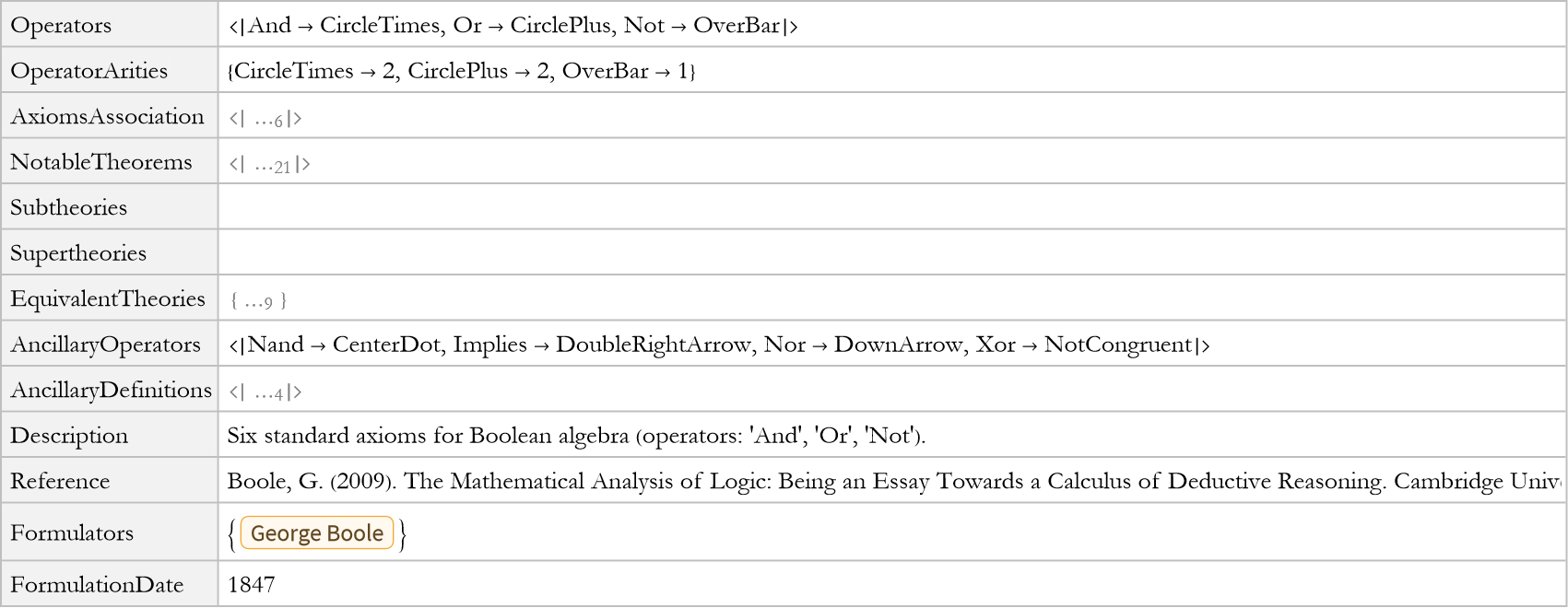
Note the strange output wrapped in <|...|>; this is called an association. Any list of objects of the form label→assignment wrapped in the <| |> end points is an association. Think of it as dictionary that Wolfram Language can use.
Note that we can actually click on part of this table. For example, we can copy the table and click on AxiomsAssociation to get the names of the axioms.
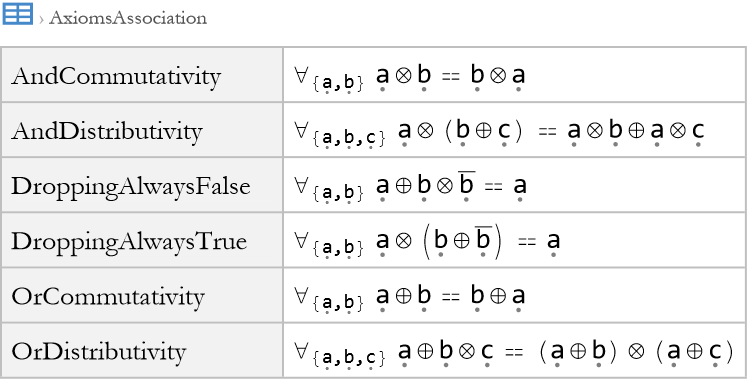
We can also see the theories in Wolfram Language that are equivalent to this by copying the dataset table and clicking on Equivalent Theories.

This raises an interesting point, what are these axiom sets? Let’s look at the Wolfram Axioms.

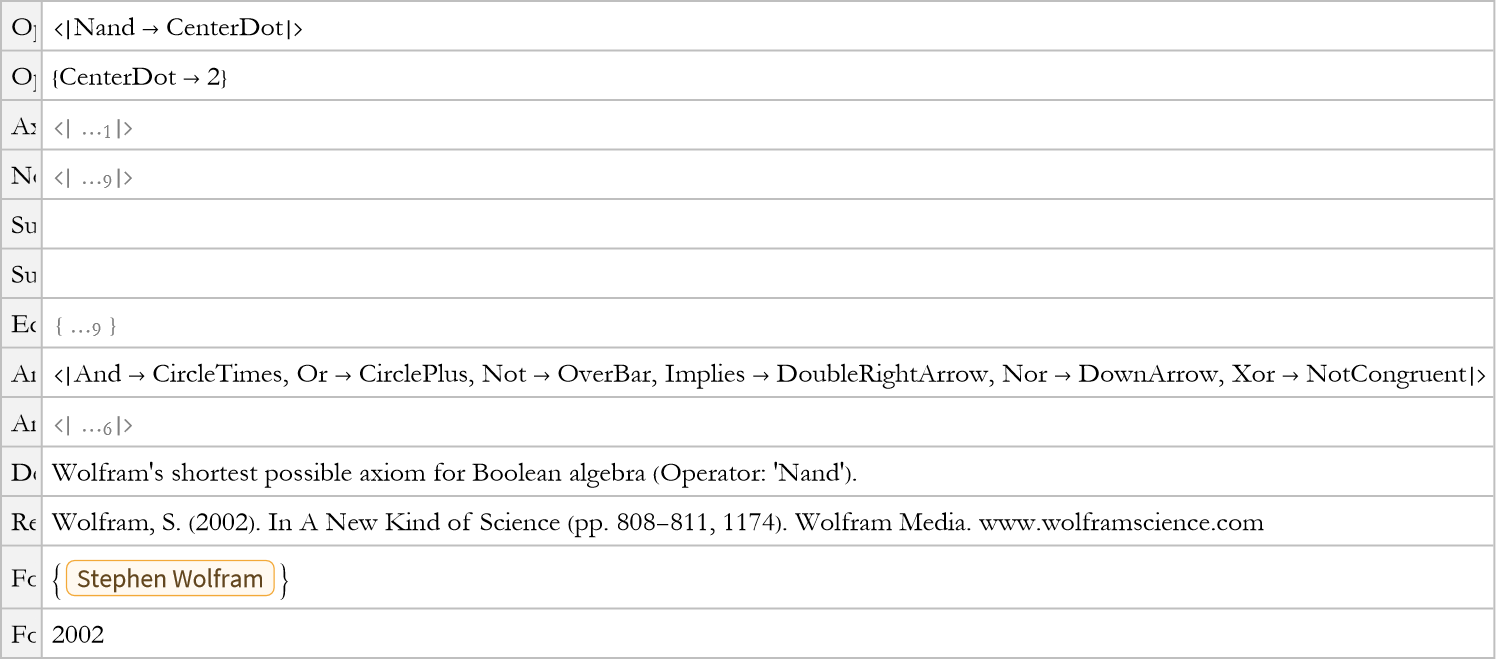


This introduces a connective we have not discussed, the center dot here represents the expression ¬(p ∧ q), called the Nand connective. There seem to be ancillary definitions.
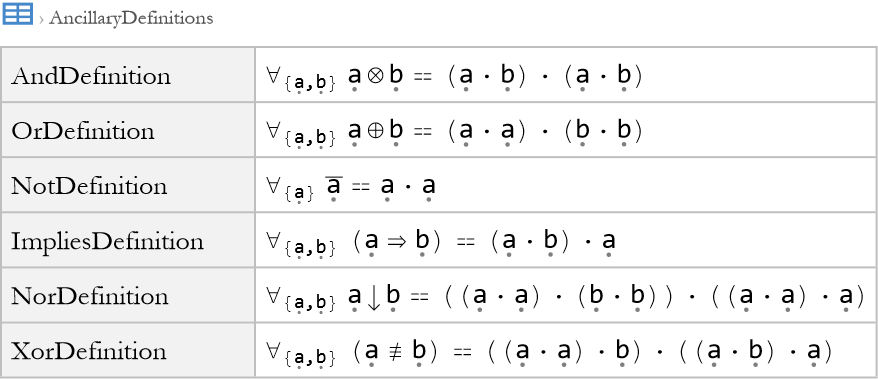
Here is another canned example from the documentation. We seek to prove the Boolean axioms using only the Wolfram axiom. We will want to specify the ancillary definitions for this.


We will attempt to use this to prove the Boolean axioms.

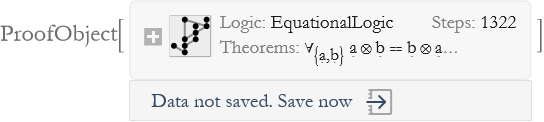
I will not produce the book required to represent this proof notebook. It is a 1,322 step proof. This took Wolfram Language less than a minute to produce. Here is a graphical representation of the structure of the proof.

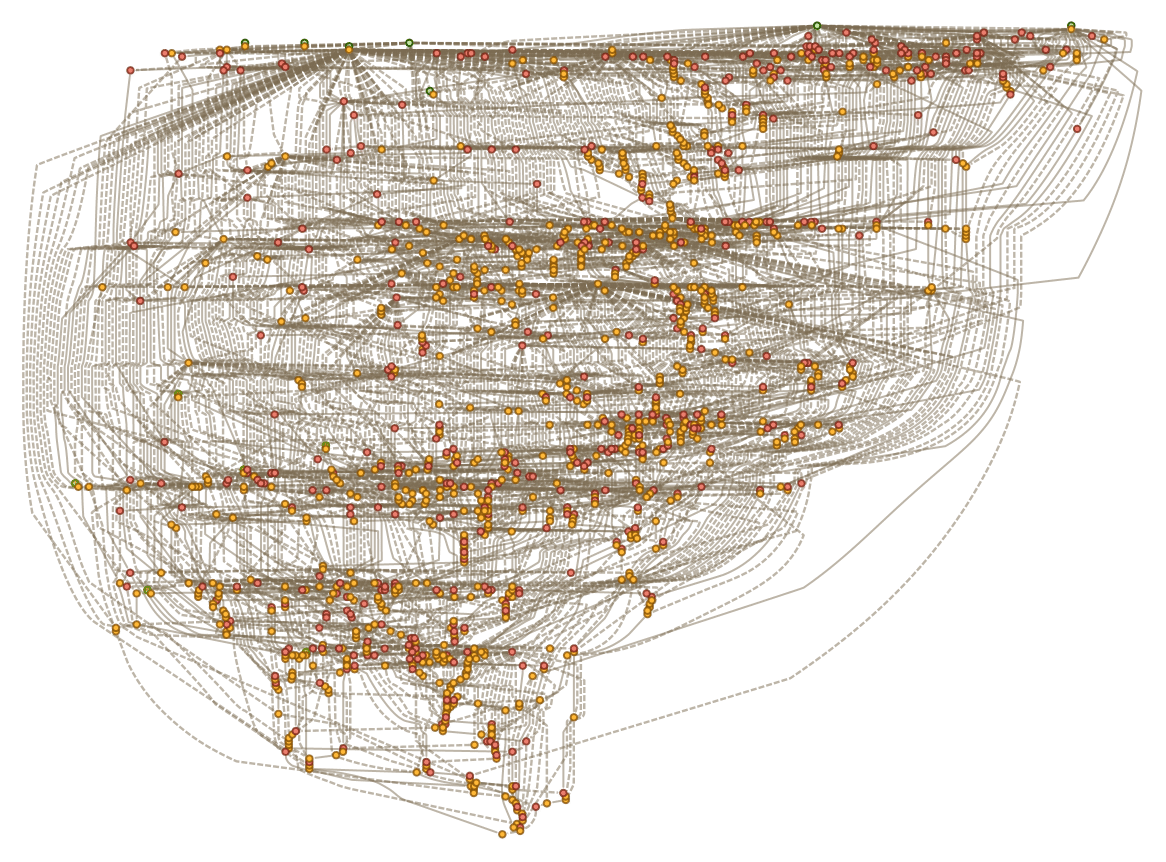
It is important to note that the logic used in FindEquationalProof is what is called equational logic. It is difficult to use the rules of inference in this form.
Here is a more specific example. If we say that all horses are green, then a horse must be green.


We can select a subset of axioms from Boolean logic (this example is also from the documentation).


We now seek to prove that ∀(p∧q) ¬(¬p∨q)∨¬(¬p∨¬q)~p.


In fact we can construct a whole system of proofs of theorems from pure mathematical logic.
So let’s examine some of the axioms systems that are displayed. We have already seen the Boolean axioms and the Wolfram axiom.

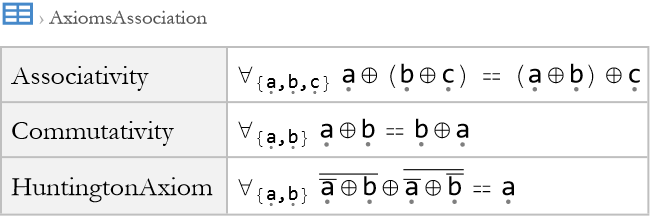

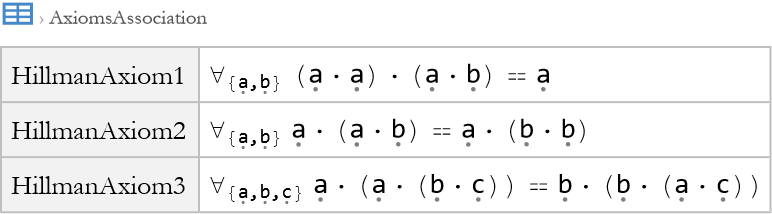

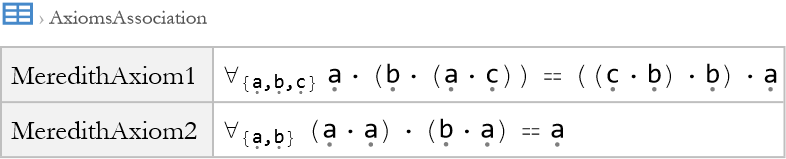



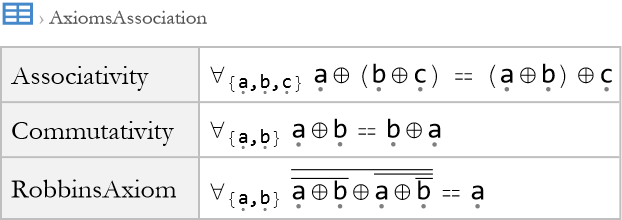






By choosing the correct axioms we can produce a wide variety or proofs.
It is also important to note that it can be very finicky in its syntax. It can be very challenging to make it work for some things. I tried to get it to perform proof of modus ponens, but was unable to work it out at the time of this writing. There is a way of confirming modus ponens, you can use the TautologyQ command.


Effectively this constructs truth tables and compares them. For example,


So this verifies the modus ponens rule by direct truth table comparison, a valid method of proof.
Undefined Terms
Term 11.3 Equational proof: A proof that derives a desired equality using only equational reasoning (substitution of equals for equals, axioms, and previously proven equalities).
Term 11.4 Axiomatic theory: A collection of axioms (basic equalities accepted without proof) that form the foundation for equational proofs.
Term 11.5 Substitution: Replacing a variable or subexpression with an equal expression throughout a statement.
Formal Definitions
Definition 11.13 AxiomaticTheory (in WL): A symbolic representation of a set of axioms (equalities) used as the basis for FindEquationalProof.
Definition 11.14 FindEquationalProof[] (Wolfram Language function): Attempts to find a proof of a target equality using a specified axiomatic theory (list of axioms).
Definition 11.15 ProofNotebook (in WL): A structured output format from FindEquationalProof that presents the proof steps in a readable, notebook-like form.
Axioms
Axiom 11.12 Axioms of equality (implicit):
Reflexivity: a = a
Symmetry: if a = b then b = a
Transitivity: if a = b and b = c then a = c
Congruence: if a = b then f(a) = f(b) for any function f
Axiom 11.13 Boolean algebra axioms (examples shown in WL):
Associativity: (a ∧ b) ∧ c = a ∧ (b ∧ c)
Commutativity: a ∧ b = b ∧ a
Distributivity: a ∧ (b ∨ c) = (a ∧ b) ∨ (a ∧ c)
Identity: a ∧ True = a
Complement: a ∧ ¬a = False
DeMorgan’s laws: ¬(a ∧ b) = ¬a ∨ ¬b
Double negation: ¬(¬a) = a
Excluded middle: a ∨ ¬a = True
Principles
Principle 11.50: Equational reasoning: Prove equalities by substituting equals for equals using axioms and prior theorems.
Principle 11.51: Substitution is the core rule: If a = b, replace any occurrence of a with b (or vice versa) in any expression.
Principle 11.52: Axiomatic theory: A set of basic equalities (axioms) serves as the foundation; all proofs derive from these.
Principle 11.53: Start from axioms: Every step must trace back to an axiom or previously proven equality.
Principle 11.54: Use substitution lemmas: Replace subexpressions while preserving equality (congruence).
Exercise 11.23: Begin with Term 11.3 and copy it into your notebook. Reflect on its meaning for a few minutes. Note any thoughts that come to mind. How would you explain this to someone sitting in front of you. Write this down. Do this for each term, definition, axiom, and principle.
Project 11.24:
Find a book on mathematical logic that lists axioms and theorems, then set about proving the theorems with FindEquationalProof or TautologyQ.
Proving an Algorithm
We now turn to the process of proving an algorithm’s correctness—a critical skill for ensuring the reliability of computational models in physics. Algorithms must be logically sound to produce reliable results. We will explore formal proof techniques—building on the logical foundations from previous sections—and use Wolfram Language’s FindEquationalProof to verify these proofs, bridging theoretical rigor with practical application.
Proving an algorithm involves demonstrating that it always produces the correct output for a given input, under specified conditions. This requires:
Preconditions: The initial assumptions or input constraints (e.g., initial velocity in a motion model).
Postconditions: The expected outcome (e.g., final position after time t).
Invariants: Properties that hold true throughout the algorithm’s execution. We use logical deductions, such as those involving equivalence and implication, to establish these relationships.
Consider a simple algorithm to calculate the final position  of an object moving with constant velocity v over time t, starting from an initial position
  . The algorithm can be expressed as:
Input: 
Output: 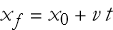 .
.
To prove this algorithm, we use a formal approach based on the axioms and lemmas from our logical framework.
Define the axioms.
Axiom 1: For all  , the position update follows the rule
 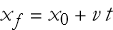 when velocity is constant.
Axiom 2: Addition and multiplication are associative and commutative over real numbers (assumed from the computational environment).
State the theorem.
Theorem: Given inputs  the algorithm
 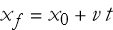 correctly computes the final position.
Construct the proof.
Assume the precondition:  is the initial position, v is the constant velocity, and t is the time elapsed.
Apply Axiom 1: The position after time t is updated by 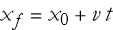 , reflecting the linear motion model.
Verify with an invariant: The difference  should equal v t. Substituting the algorithm’s output,
  , which holds true.
Conclusion: The postcondition 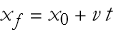 is satisfied, proving the algorithm correct for all valid inputs.
Undefined Terms
Term 11.6 Precondition: The initial assumptions or input constraints that must hold true before the algorithm begins (e.g., initial position, velocity, time are defined).
Term 11.7 Postcondition: The expected final state or output that the algorithm must guarantee if the precondition holds (e.g., final position 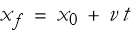 ).
).
Term 11.8 Invariant: A property or condition that remains true throughout every step of the algorithm’s execution (e.g., the difference  equals v t at all times).
Term 11.9 Correctness: The property that an algorithm always produces the correct output (satisfies the postcondition) for any valid input satisfying the precondition.
Formal Definitions
Definition 11.16 Algorithm correctness: An algorithm is correct if, whenever the precondition holds, the postcondition is guaranteed to hold after execution.
Axioms
Axiom 11.14 Axiom of constant velocity motion: If velocity v is constant, then the change in position over time t is exactly v t (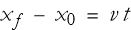 ).
).
Principles
Principle 11.55: Algorithm correctness requires proving that the postcondition holds whenever the precondition is true.
Principle 11.56: Invariants are properties that remain true at every step—use them to prove correctness across iterations.
Principle 11.57: General proof strategy for algorithms:
State precondition and postcondition clearly.
Identify invariants that hold initially, after each step, and at termination.
Show each step preserves invariants.
Show postcondition follows from invariants at end.
Principle 11.56: Invariants bridge steps: They connect initial state to final state logically.
Principle 11.57: Practice with simple cases: Prove correctness for constant velocity, then extend to acceleration.
Principle 11.58: Proofs turn algorithms into trusted tools — foundational for computational physics and theoretical modeling.
Exercise 11.25: Begin with Term 11.6 and copy it into your notebook. Reflect on its meaning for a few minutes. Note any thoughts that come to mind. How would you explain this to someone sitting in front of you. Write this down. Do this for each term, definition, axiom, and principle.
Exercise 11.26:
a) Consider a modified algorithm where 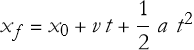 (including constant acceleration a). Define new axioms: Axiom 1:
 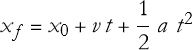 for constant acceleration. Axiom 2: Addition and multiplication are associative and commutative. State the theorem and construct a proof, identifying preconditions (e.g., a constant) and an invariant (e.g., displacement rate).
b) For the uniform motion algorithm from Exercises 11.14 a), assume preconditions  , v=2, and t=3. Compute
  and verify the postcondition
  . Write a proof that the algorithm holds for these specific values, then generalize it using a logical deduction based on Axiom 1.
c) Design an invariant for the uniform motion algorithm from Exercises 11.14 a), such as “the change in position is proportional to time and velocity.” Incorporate this invariant into a proof of correctness, starting from the preconditions and using Axiom 1. Explain how the invariant ensures the algorithm’s reliability throughout execution.
d) Consider an algorithm with two steps:
Step 1: Compute intermediate velocity 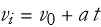 (assuming constant acceleration).
Step 2: Compute final position 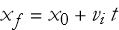 .
.
Define axioms for each step and state the theorem  . Construct a proof, identifying preconditions (e.g., a constant) and postconditions, and verify the result.
e) Analyze the following flawed algorithm: 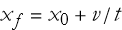 (intended for uniform motion). Identify why it fails. Propose corrected preconditions and a new theorem. Write a proof of the corrected version.
Formalizing Lesson 3
Go through Lesson 3 and list the undefined terms, formal definitions, axioms, principles, and theorems.
Formalizing Lesson 4
Go through Lesson 4 and list the undefined terms, formal definitions, axioms, principles, and theorems.
Formalizing Lesson 5
Go through Lesson 5 and list the undefined terms, formal definitions, axioms, principles, and theorems.
Formalizing Lesson 6
Go through Lesson 6 and list the undefined terms, formal definitions, axioms, principles, and theorems.
Formalizing Lesson 7
Go through Lesson 7 and list the undefined terms, formal definitions, axioms, principles, and theorems.
Formalizing Lesson 8
Go through Lesson 8 and list the undefined terms, formal definitions, axioms, principles, and theorems.
Formalizing Lesson 9
Go through Lesson 9 and list the undefined terms, formal definitions, axioms, principles, and theorems.
Formalizing Lesson 10
Go through Lesson 10 and list the undefined terms, formal definitions, axioms, principles, and theorems.
Formalizing This Chapter
Go through this lesson and list the undefined terms, formal definitions, axioms, principles, and theorems prior to the section Axiomatic Systems.
For Further Study
Douglas Smith, Maurice Eggen, Richard St. Andre, (2014), A Transition to Advanced Mathematics. Cengage Learning 8th Edition. This is a very nice presentation of this material. It extends these ideas to set theory, numbers, algebra, and calculus.
Daniel J. Vellerman, (2019), How to Prove It: A Structured Approach. Cambridge University Press (3rd Edition). Lots of university students swear by this book. It is very readable.
Steven Galovich, (1989), Introduction to Mathematical Structures. Harcourt Brace Janovich Publishers and Its Subsidiary, Academic Press. This is my favorite book on the subject of this lesson.
Introduction to Proofs (Khan Academy) Link: https://www.khanacademy.org/math/geometry/hs-geo-foundations/hs-geo-proof-foundations/v/introduction-to-proof . Duration: 10 minutes. Starts with basic proof strategies (direct proof, contradiction), with examples and interactive elements.
Logical Connectives and Truth Tables (Art of Problem Solving) Link: https://artofproblemsolving.com/wiki/index.php/Logic (embedded video)
Duration: 12 minutes. Covers conjunction, disjunction, negation, and truth tables with simple visuals. AoPS style is rigorous yet accessible, tying to proof techniques.
Proof by Contradiction (Eddie Woo, YouTube) Link: https://www.youtube.com/watch?v=1S0aBV-Waeo . Duration: 8 minutes. Step-by-step example of contradiction proofs, using everyday logic. Engaging teacher with whiteboard demos, ideal for beginners.
Quantifiers: For All and There Exists (The Math Sorcerer, YouTube) Link: https://www.youtube.com/watch?v=0x3V7p0w3xQ . Duration: 15 minutes. Explains universal (∀) and existential (∃) quantifiers with clear examples and negations. Ties directly to predicate logic in proofs.
Proofs: Direct and Contraposition (TrevTutor, YouTube) Link: https://www.youtube.com/watch?v=2Yq4b7l6Q2s . Duration: 11 minutes. Compares direct proofs and contraposition with simple algebra examples, building logical transparency. Short and focused.
Mathematical Proofs: An Introduction (blackpenredpen, YouTube) Link: https://www.youtube.com/watch?v=3h3i3n5q5zM . Duration: 9 minutes. Overview of proof types (direct, contradiction, induction) with humor and visuals.





